Modernization is translation
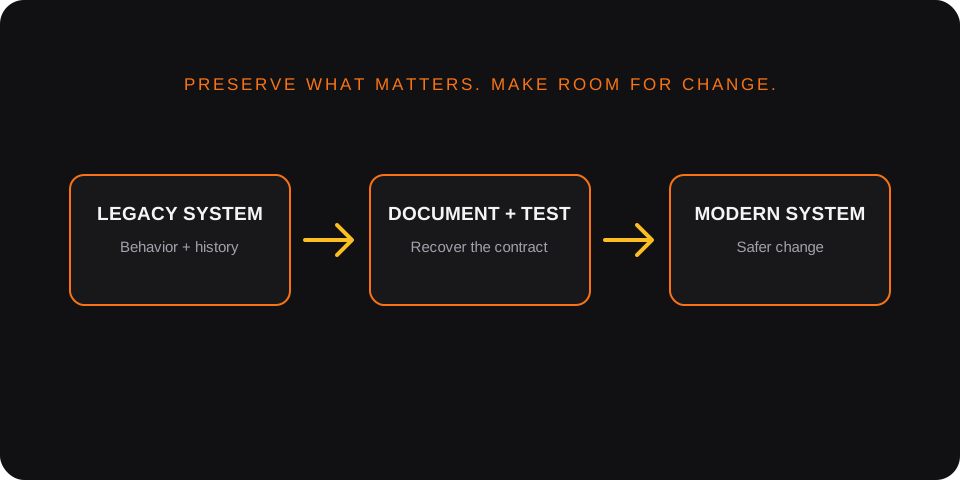
Modernization is not a demolition job. It is translation: understanding why something exists, preserving what matters, and creating room for a safer future. A legacy rule may look awkward in isolation because the business constraint that shaped it lives somewhere else—in an old incident report, a downstream file format, or a promise made to a customer.
Replacing the code before recovering that context can make a system cleaner and less correct at the same time. The first task is therefore not to rewrite. It is to find the contract: what enters the system, what must remain true, and which edge cases people quietly rely on.
That work can feel slower than opening an editor, but it changes the quality of every decision that follows. A migration plan grounded in evidence can separate essential behavior from accidental complexity instead of carrying both forward blindly.
Curiosity is an engineering tool
Curiosity is often treated as a personality trait, but in engineering it is a method. Ask why a field is nullable. Ask which team consumes an export. Ask what happens when a batch is replayed. Each question tests an assumption before it becomes a production defect.
The same habit applies outside code. When a decision seems obvious, curiosity slows us down just enough to notice what we may have left out. It makes room for a second explanation and a better question.
This does not mean analysis should continue forever. A useful investigation has a boundary: gather enough evidence to make a reversible decision, record what remains uncertain, and learn from the result. The goal is not perfect certainty; it is a clearer next step.
Leave a clearer path
The best modernization work leaves more than a new implementation. It leaves a map: documented invariants, representative test cases, known failure modes, and a safe way to compare old and new behavior.
That map helps the next engineer move with confidence instead of rediscovering the same history under deadline pressure. The long way around is not valuable because it is long. It is valuable when the extra attention prevents us from mistaking speed for progress.
That slower look is where better systems—and better ideas—usually begin.
Turn recovered knowledge into executable evidence
Once the behavior is understood, capture it where it can protect future changes. A small set of representative input-output fixtures can document edge cases better than a long prose description alone. Property tests can express invariants—such as stable ordering or a conservation rule—while integration tests verify that file formats and service boundaries still agree.
During a migration, compare old and new outputs on the same sanitized inputs. Differences are not automatically defects: some may be intentional corrections, while others may expose an assumption nobody had written down. Categorize them, ask the domain owner, and record the decision so the next comparison has context.
This is one reason migration tooling deserves the same care as production code. Reproducible inputs, deterministic runs, useful diff reports, and clear provenance make it possible to investigate a mismatch without guessing which version produced it.
Leave uncertainty visible
Not every behavior can be recovered before work begins. Some dependencies are unavailable, old data is incomplete, or a business rule has changed since the system was written. Label those unknowns explicitly and decide whether to block the migration, isolate the uncertainty, or proceed with a monitored assumption.
A clear record of uncertainty is not an admission of poor engineering. It is a way to prevent a guess from quietly becoming a permanent contract. The team can then revisit the assumption with evidence instead of rediscovering it through an incident.
Curiosity gives modernization its direction; tests and decision records give it a memory. Together they make the long way around a route toward safer change rather than an excuse to delay it.
Loading comments…