Start with the moment that needs help
Agentic systems make it tempting to automate everything. A better starting point is to map the moments where people lose context, repeat a decision, or need a small amount of synthesis.
Imagine an analyst reviewing a long incident thread. The useful intervention may be a concise timeline and a list of unresolved decisions—not an agent that silently changes the ticket, emails stakeholders, and declares the incident resolved. Start by finding the repeated cognitive work, then decide what the system can safely prepare.
A practical design exercise is to write down the user's goal, the evidence available to the model, the action the model may take, and the moment a person must confirm. If those boundaries are hard to explain, the feature is probably trying to do too much.
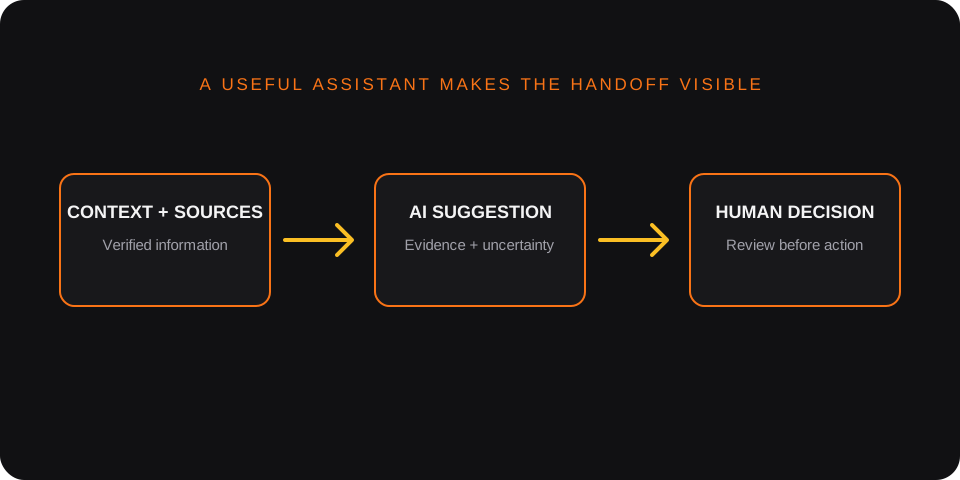
Design the handoff, not just the answer
A helpful answer is only one part of an interaction. People need to understand where it came from, what assumptions it made, and what to do next. Showing the source beside a summary makes verification cheaper. Showing uncertainty gives a person permission to slow down when the evidence is incomplete.
The interface should also make the boundary between preparation and action unmistakable. Drafting a Jira ticket is different from assigning it. Suggesting a reply is different from sending it. A confirmation step should summarize the intended action and its consequences, not merely ask “Are you sure?”
When a system cannot find enough evidence, the right response is not a plausible completion. It is an explicit gap: what could not be verified, what source was missing, and how the person can proceed safely.
Measure whether the next decision got easier
Model accuracy matters, but it is not the whole product outcome. Measure whether users spend less time reconstructing context, whether they can verify an answer, how often they correct a generated draft, and whether an automation creates extra review work.
I keep returning to one question: does this make the next decision easier? If the answer is yes—and the system remains understandable when it is unsure—the model is doing useful work. If not, more autonomy will only make the wrong interaction happen faster.
Treat quality as a product loop
A useful evaluation set should come from real tasks, with permission and sensitive information removed. Include ordinary cases, ambiguous requests, missing sources, and situations where the correct action is to decline. Ask reviewers to score not only factual correctness but also whether the answer is traceable, appropriately scoped, and easy to correct.
Pair offline evaluation with product signals: how often suggestions are accepted unchanged, edited, dismissed, or followed by a clarification request. None of those signals is a perfect proxy for value, so interpret them together and review examples. A high acceptance rate can mean excellent assistance—or that the interface makes disagreement too difficult.
Finally, make iteration safe. Version prompts and retrieval settings, compare changes against a stable evaluation set, and roll out behind a feature flag where possible. That gives the team a way to learn without making every experiment a permanent behavior change for every user.
Make the safest useful action the default
The right amount of autonomy depends on reversibility and impact. Summarizing a document is easy to undo; changing access permissions is not. A useful design classifies actions by consequence, requires stronger confirmation for higher-impact changes, and records what happened so the user can understand and recover.
This is where interface design and system architecture meet. A clear preview is only trustworthy if the backend enforces the same scope the preview described. A good confirmation flow is backed by authorization checks, idempotent operations, audit records, and a way to report partial failure honestly.
AI feels helpful when it removes unnecessary effort without removing meaningful control. That is a narrower goal than “automate everything,” but it is also a much more dependable one.
Loading comments…