Define the contract at every boundary
An API promises a response shape. A booking flow promises that a seat shown as available can still be claimed. An AI assistant promises—sometimes by tone alone—that its answer is grounded enough to act on.
Each boundary needs a clear contract: what the caller provides, what the service guarantees, and which errors are retryable or final. A route-search service should distinguish “no feasible itinerary” from “search could not complete” and “results may be stale.” Those states lead to different decisions.
A data migration has an equally important contract: which input rows should be present, how fields are interpreted, which transformations are permitted to change, and how output completeness is established. C and Java can differ in representation, numeric conversion, string handling, and null conventions. If those rules remain implicit, a program can produce a syntactically valid file while violating the business meaning of the record.
Make state and provenance visible
Distributed work includes intermediate states: requested, pending, confirmed, expired, and cancelled. Naming them prevents a boolean such as `done: true` from carrying several meanings. A seat should not appear reserved merely because it appeared in search results.
Retries need stable request identifiers so a repeated request can be recognized rather than performed twice. Idempotency is not just an optimization; it makes retries safe.
Observability helps engineers investigate through logs, metrics, and traces. Products also need user-facing observability: clear progress, visible uncertainty, and recovery choices that reflect the actual state.
AI must be allowed to say what it cannot verify
Fluent language can make weak evidence sound settled. A reliable AI feature needs explicit boundaries: what it can access, which actions it may take, when approval is required, and what it does when sources disagree. It should be able to say, “I could not verify this,” and leave the user with a safe next step.
The quiet contract of a system is not that nothing will fail. It is that failure will not masquerade as success. Make boundaries clear, state inspectable, and recovery truthful. That is how software earns trust—not by pretending to be infallible, but by being understandable when it is not.
Make recovery part of the original design
A recovery path should be designed alongside the happy path. For a retryable operation, explain whether retrying is safe and ensure the operation is idempotent. For a partial result, state which parts completed and which did not. For an irreversible action, provide a preview and an explicit confirmation before the system crosses the boundary.
These details are not merely interface polish. They influence API contracts, persistence, job orchestration, and auditability. A system that records a request identifier and state transition can tell whether a retry is resuming work or creating a duplicate. A system that records only a final boolean cannot.
Recovery should also be proportionate. If a recommendation was uncertain, invite verification; do not force a full restart. If a workflow cannot continue safely, preserve the evidence and give a clear escalation route instead of hiding the failed state.
Observe what people experience
Operational dashboards tend to report service-level facts: latency, errors, queue depth, and availability. Those are necessary, but product reliability also needs measures such as stale-result rate, duplicate-action rate, user correction frequency, and time to recover from a failed workflow.
These measures need context and privacy protections. Aggregate where possible, avoid logging secrets or unnecessary personal content, and retain enough structured identifiers to trace a failure without turning observability into a second database of sensitive information.
A dependable system does not claim that every response is certain or every dependency is healthy. It makes the limits visible, records what actually happened, and offers a recovery path that matches reality.
Compare meaning, not just bytes
A field-by-field diff is useful only when its comparison rules match the domain contract. Byte equality can flag harmless serialization differences such as padding or format changes; loose equality can hide important distinctions such as a missing value versus an explicit zero. Normalize only where the contract permits it, and keep both raw and normalized values in the evidence record.
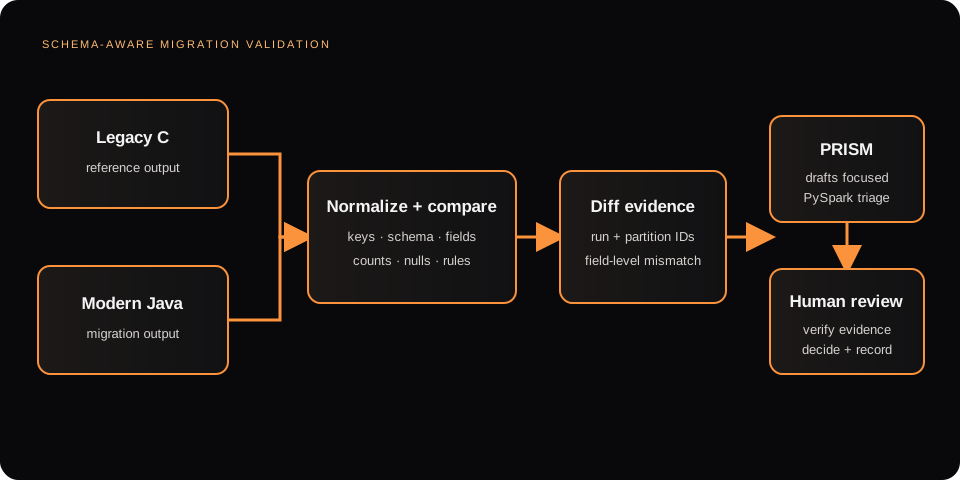
A reliable reconciliation pass starts with structural checks: counts, duplicate keys, missing keys, and unexpected records. It then compares mapped fields using explicit rules for nulls, dates, scale, whitespace, and code pages. Differences should be categorized—missing row, extra row, field mismatch, parse failure—so an engineer can route each class to the right investigation instead of staring at one enormous text diff.
At enterprise scale, partitioning and deterministic keys make the work tractable. Comparisons can be distributed across partitions, but the output must remain reproducible: stable sort keys, run identifiers, source file checksums, schema versions, and code versions help answer which exact inputs produced a mismatch. The following Java example is illustrative; it shows the comparison boundary rather than proprietary production code.
for (String field : schema.comparableFields()) {
    Object oldValue = normalize(field, legacy.get(field));
    Object newValue = normalize(field, modern.get(field));

    if (!Objects.equals(oldValue, newValue)) {
        differences.add(new FieldDifference(
            recordKey, field, oldValue, newValue, runId));
    }
}| Difference class | Example | Useful next check |
|---|---|---|
| Missing key | Legacy row has no Java counterpart | Partition counts, key parsing, filtering rules |
| Field mismatch | Same key, different normalized amount | Scale, rounding, sign, and business-rule mapping |
| Schema mismatch | Unexpected or absent output column | Schema version, mapping configuration, serializer |
| Duplicate key | More than one row for a supposedly unique key | Join cardinality, source duplication, deduplication contract |
Let PRISM turn comparison evidence into a focused query
The comparison engine narrows the search space; PRISM helps make the next investigation faster. The agent can use schema and data-architecture context to interpret categorized compare logs, identify relevant partitions and columns, and draft a PySpark query that fetches a small, explainable sample. This is the practical role of AI in the workflow: reduce repetitive query-authoring, not invent a root cause.
A generated query should be constrained to approved datasets and known columns, validated before execution, and presented with the compare-log entries that motivated it. It should not receive unrestricted access to production data simply because a prompt asks for more context. Engineers still verify the sample, inspect transformation logic, and decide whether a discrepancy is a defect, an intentional behavior change, or an unresolved rule.
A representative PySpark investigation might isolate a known mismatch class by run, partition, and field. The exact table names and column mappings are environment-specific, so this snippet is illustrative and uses neutral identifiers.
mismatches = (
    spark.read.table("reconciliation.field_differences")
    .where(col("run_id") == requested_run)
    .where(col("field_name") == requested_field)
    .select("record_key", "legacy_value", "java_value", "partition_id")
    .limit(100)
)
mismatches.orderBy("partition_id", "record_key").show(truncate=False)
Protect correctness while reducing triage time
The result of a comparison system is not only a pass or fail. It is an investigation trail: what was compared, how values were normalized, which fields differed, and what query or follow-up action was proposed. That makes a repeated migration run easier to reason about and gives reviewers a basis for approving changes without relying on memory.
The reported outcome of this work was reconciliation across more than 1,000 assets containing millions of records and a 40% reduction in Spark-job failure triage time. The important distinction is that faster triage came from structured evidence and a targeted assistant working together—not from asking a language model to certify financial data.
For any migration involving sensitive records, examples and logs should avoid exposing unnecessary personal or financial information. Use stable non-sensitive identifiers where possible, constrain retention, redact values that are not needed for diagnosis, and audit access to the reconciliation output. Observability should improve correctness without creating a second uncontrolled copy of the data.
Make the failure legible to the next engineer
A useful report gives the next engineer a starting point: run ID, code and schema versions, input fingerprints, counts, affected partitions, mismatch categories, and representative records with sensitive values protected. It also makes the status explicit: comparison completed, comparison incomplete, query generation failed, or a human decision is still required.
That information turns a failure from a vague red indicator into a sequence of testable questions. Did the source change? Did a transformation behave differently? Is the mismatch expected under a new rule? Did a data-quality issue arrive before the migration? The team can answer those questions with evidence and record the decision for the next run.
Reliability is not pretending every migration is correct on the first attempt. It is making incorrectness detectable, investigation repeatable, and recovery safer than guesswork.
Use shadow comparisons before switching traffic
A safer migration strategy compares legacy and modern behavior before the new implementation becomes authoritative. Run both versions against the same controlled inputs where practical, preserve the source and output fingerprints, and reconcile the results in a shadow workflow. This exposes differences while the legacy path is still available as a reference. For large batch workloads, comparisons can be staged by asset or partition so teams can learn from a representative slice before broadening the run.
The acceptance gate should be explicit. Define which fields must match exactly, which are normalized by contract, which differences require a business decision, and what completeness checks must pass. Do not reduce this to “the Spark job finished.” A successful job can still omit an input partition or write a partially correct output. Track processed counts, rejected records, duplicate keys, and categorized differences alongside execution status.
When a mismatch is approved as an intentional behavior change, record the rule, owner, evidence, and effective version. That turns the next migration run into a comparison against a known decision rather than reopening an old debate. It also keeps the validation harness from treating every difference as an error or, just as dangerously, teaching it to ignore a difference with no documented reason.
Measure the investigation loop, not just job duration
Batch duration is only one part of migration efficiency. A faster run can still leave engineers searching logs for hours. Useful operational measures include the time from first mismatch to a reproducible query, the fraction of differences categorized automatically, the number of manual reruns needed, and how often an investigation identifies a data issue versus a code defect. These metrics reveal whether diagnostics actually help.
The 40% triage-time reduction associated with the PRISM work is meaningful because it concerns the investigation loop, not a claim that the model made the migration correct. Preserve a baseline and compare equivalent classes of failures; otherwise, a shift in workload can make the metric misleading. Review samples of generated queries and human corrections to see whether the assistant is helping consistently or only on easy cases.
Finally, retain less data, not more. A durable run identifier and masked keys may be enough to connect the report to secure source records. Avoid placing full financial values in prompts or broad logs, apply access controls to reconciliation outputs, and define retention limits. Good failure visibility makes a system easier to repair without making sensitive information easier to expose.
Loading comments…