Give every tool a clear job
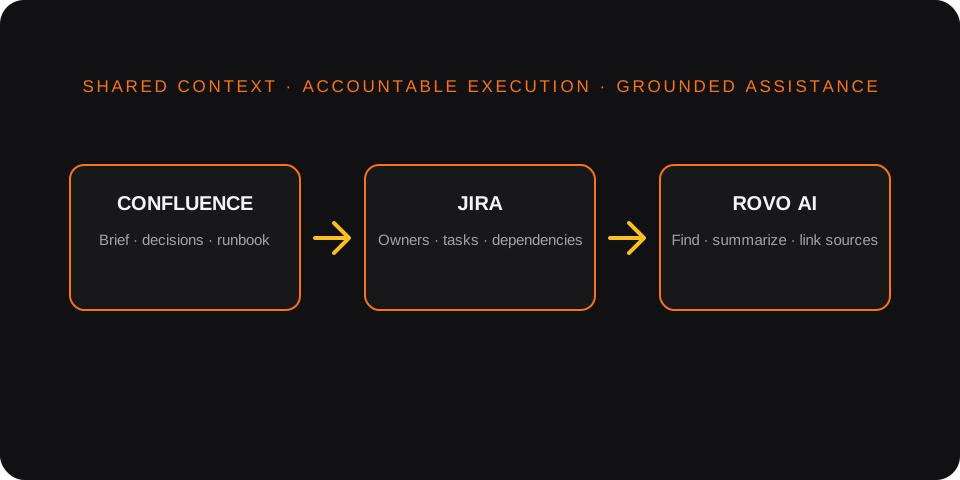
Confluence provides the durable narrative: the event brief, decisions, audience, constraints, runbook, and post-event notes. Jira turns that narrative into accountable work: tasks with owners, due dates, dependencies, and explicit states. Rovo can help people find and synthesize relevant context across connected knowledge they are permitted to access.
The workflow begins with structured intake: purpose, audience, date range, format, budget constraints, expected attendance, and decision-makers. Rovo can summarize the request, surface similar past events, and draft a plan from approved material. That draft should link to its sources and remain a proposal—not silently become a promise.
Turn the plan into visible execution
After review, the plan can become Jira work for logistics, speakers, communications, registration, technology, and day-of operations. Dependencies become visible. A late venue confirmation can be shown as a risk to downstream work instead of being buried in meeting notes.
Confluence remains the place where the team reads the current runbook; Jira remains the place where owners update work. Predictable transitions can trigger checklists, due-date reminders, or approval requests. Rovo can help answer “What is still blocked?” or “Which decisions changed?”—provided records are current and access rules are respected.
Keep humans accountable for consequential actions
People should retain control over commitments such as spending, broad communications, event changes, and assignments beyond agreed ownership. AI summaries should preserve links to evidence; stale or conflicting information should be surfaced, not flattened into confident prose.
Governance matters as much as tooling: clear project permissions, one canonical source for each fact, consistent naming, and a distinction between confirmed decisions and generated suggestions.
Success is not the number of automations. It is whether people can quickly answer what happens next, who owns it, what is blocked, and which plan is current. Jira captures execution, Confluence preserves shared understanding, and Rovo reduces the effort of finding and connecting that understanding. Together, they can form a practical coordination layer for complex events.
Orchestrate the event lifecycle, not just the launch
A useful workflow follows the event from intake through closeout. During planning, the team confirms scope, owners, dependencies, and decision deadlines. During preparation, task status and open risks can feed a concise readiness review. On event day, a runbook should prioritize operational facts—contacts, timings, escalation paths, and fallback plans—over generated prose.
After the event, attendance, feedback, incident notes, and budget reconciliation can be gathered into a retrospective. Rovo may help summarize themes, but the team should preserve source links and distinguish participant feedback from an agent's interpretation. Follow-up actions should be reviewed and assigned deliberately.
This lifecycle view prevents a common automation trap: optimizing the kickoff while leaving handoffs and closeout manual. The event is only complete when commitments are tracked and reusable learning is captured in a place the next team can find.
Design signals and fallbacks before automating
A useful alert has an owner, a deadline, and a next action. “Task overdue” is a weak signal if nobody knows whether it threatens the venue booking or merely a draft agenda. Connect critical tasks to explicit dependencies and escalate only when a meaningful threshold is crossed.
Every integration needs a fallback. If a Jira automation fails, the task must remain visible and a human should be able to continue the workflow. If Rovo cannot access a source, the answer should say so and link to the approved location rather than inventing a summary.
Finally, review permissions and retention. Event plans can include attendee information, vendor terms, and internal decisions. Connect only the knowledge spaces the workflow needs, avoid copying personal data into broad channels, and decide how long operational records should remain available.
Use a state machine for operational readiness
A checklist is useful, but a readiness state is more useful when it has a defined meaning. For example, an event can move from Draft to Planning, Ready for Review, Approved, Live, and Closed. Each transition should declare its prerequisites: a venue confirmation may be required before approval, while a post-event report belongs after closeout.
This model prevents dashboards from presenting a pile of completed tasks as a reliable event status. A task can be done while a dependency is still unresolved; a state transition can evaluate the critical prerequisites and surface the blocker. Jira issue types, workflow conditions, and automation rules can express parts of this contract, while Confluence documents what each state means to the people using it.
The model should remain simple enough that event owners can predict it. If a transition cannot be explained without reading automation source, the workflow is too clever. Start with a few meaningful gates, name the owner for each decision, and add automation only where it removes repetitive coordination without concealing accountability.
| State | Evidence required | Human decision |
|---|---|---|
| Planning | Brief, scope, owner, and target date | Confirm the event is worth planning |
| Ready for review | Critical tasks assigned; risks and costs visible | Review scope and unresolved dependencies |
| Approved | Required approvals and fallback plans recorded | Authorize commitments and communications |
| Closed | Actuals, feedback, incidents, and follow-ups captured | Accept closeout and archive the runbook |
Treat webhooks as at-least-once signals
Integrations should assume that webhook delivery can be delayed, duplicated, or arrive out of order. A receiver should validate the request, store the provider event identifier, acknowledge quickly, and process work asynchronously. If the same event arrives again, idempotency prevents a second Jira issue or a repeated external notification.
Do not use an event payload as the only source of truth. Fetch current issue state when necessary, compare the transition with the last processed version, and make the handler safe to retry. If a downstream API is unavailable, record a retryable job and expose the failure to an operator instead of dropping the event after a successful HTTP response.
The following is deliberately provider-neutral pseudocode: actual webhook signatures, event fields, and retry contracts differ by product and configuration. The reliable pattern is durable receipt, idempotent processing, and observable failure—not assuming a webhook behaves like a transaction across three tools.
receive(event):
  verify_signature(event)
  if event.id already processed: acknowledge and stop
  persist(event.id, status="received")
  enqueue(event.id)
  acknowledge

worker(eventId):
  load current Jira state
  apply allowed transition once
  update Confluence context if required
  persist status or retryable failure
Give Rovo bounded work and evidence
A Rovo-assisted workflow is most useful for discovery and preparation: find similar past events, summarize approved source material, identify conflicting dates, or draft a checklist. The result should carry references back to Confluence pages and Jira issues, along with a timestamp or version where the integration exposes one. That lets an event lead verify whether a recommendation is still current.
Keep generated content outside the source of truth until a person accepts it. An agent can prepare a proposed set of tasks, but creating assignments, promising a budget, or sending a broad announcement should require an authorized human decision. Permission trimming matters: the workflow must not expose content the requesting user could not access directly.
When sources disagree, the system should report the conflict rather than choose the latest-looking sentence. When a source is unavailable, it should label the gap. These behaviors turn Rovo from an opaque authority into a useful coordination assistant that helps teams find context faster while leaving responsibility visible.
Measure operational confidence, not automation volume
A successful integration is not measured by how many Jira issues it creates. Track whether critical dependencies are discovered earlier, how long high-risk blockers remain unresolved, whether teams can identify the current runbook, and how often an automation needs manual repair. For AI-generated drafts, sample outputs for citation coverage, stale facts, and human correction.
Keep the event itself resilient to a broken integration. The runbook should be readable without the AI layer, essential decisions should have human owners, and an operator should be able to resume a workflow from durable state. The system is valuable when it shortens coordination loops; it is trustworthy when it also makes its own limits and failures visible.
Together, Jira, Confluence, and Rovo can connect execution, durable context, and discovery. Their value comes from a well-defined handoff between those responsibilities—not from collapsing them into one automation that nobody can inspect.
Design the event-day operating picture
Planning data becomes most valuable when the event is underway. The runbook should answer a small set of urgent questions quickly: what is happening now, who owns the next transition, which supplier or speaker is not confirmed, and how the team escalates a problem. Keep the live view focused on these operational facts rather than reproducing every planning document in one crowded dashboard.
A readiness view can be generated from Jira status and dependencies, but it should distinguish a task that is merely late from a critical blocker that threatens a commitment. Define severity and escalation rules with the people who operate the event. Give each alert a named owner, response expectation, and fallback contact. A message without a next action is noise, especially during a live operation.
Confluence provides a natural home for the canonical runbook and decision log. Jira can link to the relevant section from each high-priority task. If Rovo summarizes changes during a planning review, preserve the source links and have an owner confirm that the update belongs in the runbook. This keeps the operational view useful without letting generated summaries silently rewrite the plan.
Make integration state observable and recoverable
An integration should expose its own health: last successful sync, oldest queued event, retry count, and events that need human attention. A green Jira board does not prove that a Confluence update succeeded, and a generated summary does not prove that it used the latest approved source. These are different signals and should be monitored separately.
Use a durable event log or queue for cross-tool work where losing an update would matter. Record the source event ID, the target issue or page, the attempted operation, and the result. If an API call times out after it may have succeeded, retrieve current state before retrying. Idempotency keys or deduplication records help prevent a second issue, comment, or notification.
Most importantly, the event must still run if an integration is unavailable. Keep contact lists and key timings in the approved runbook, nominate a human to own manual updates, and test the fallback before event day. An automation is operationally mature when its failure is visible and the team can continue safely—not when the happy-path demo looks seamless.
Loading comments…